


Have you ever thought nightclub soundproofing could wait because, if a problem arose, you could simply turn the music down?
This is a common assumption when investing in a nightclub, lounge, or hospitality venue with a high-output sound system.
Many owners readily invest in loudspeakers because they can see and hear their effect as soon as the venue opens. Soundproofing is harder to picture. Before the building management or neighbors raise a complaint, it can seem like something to consider later.
Once the venue is operating, however, the problem often cannot be solved by turning one control.
Sound Does More Than Travel from Loudspeaker to Ear
In Auditorium Acoustics 101: The Quieter, the Better, acoustical engineer Art Noxon presents an illustrative example.
For a space of approximately 743 m² holding 1,000 people, with the loudspeaker cluster around 15.24 m from the listeners, the combined area of the audience’s ears receives only about 0.17% of the direct sound emitted by the loudspeakers.
For an individual listener, the proportion is smaller still: approximately 0.00017%.
The remaining sound continues into the space, where it can reach walls, ceilings, floors, and other surfaces before being reflected or propagating further.
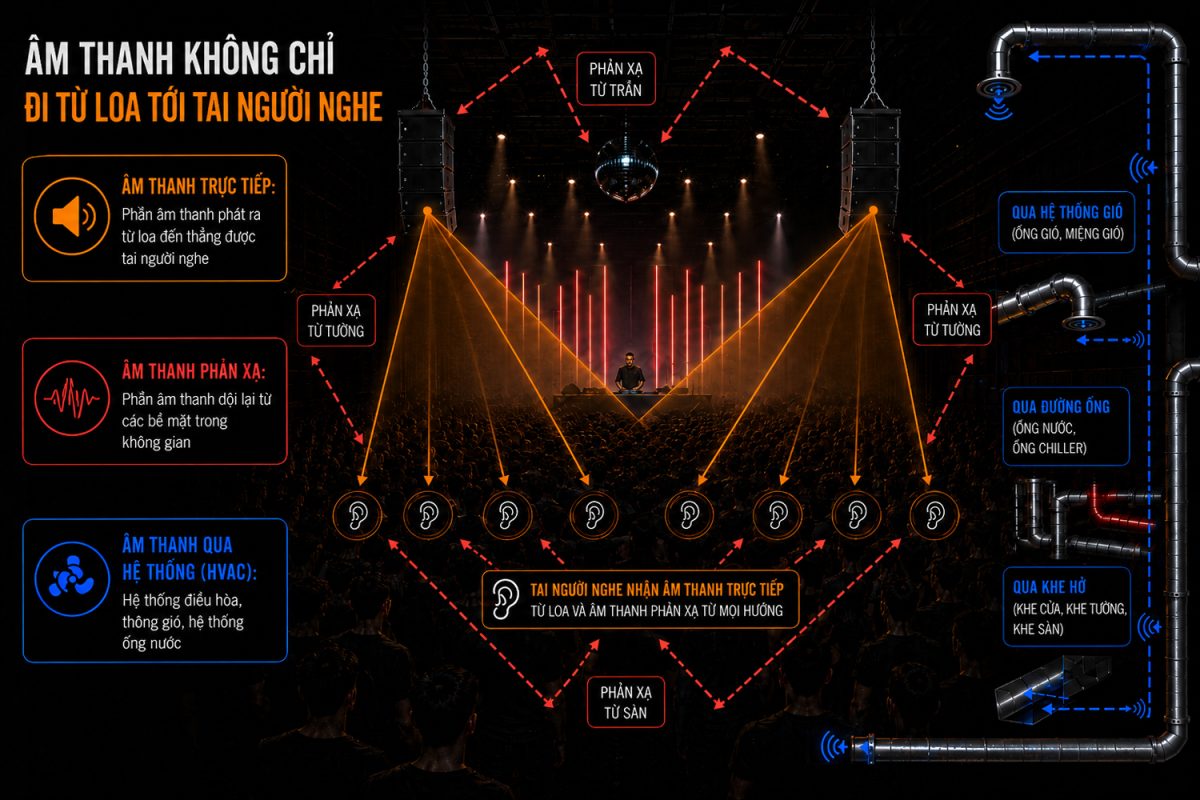
This illustration is not a fixed formula for every room. It highlights an important principle:
Selecting good loudspeakers is only part of the task. The sound that continues to interact with the room must also be considered.
Good Equipment Needs an Acoustically Prepared Space
Indirect sound is not inherently undesirable.
When controlled appropriately, it can contribute to a pleasant listening experience. Left unmanaged, echoes, reverberation, and unwanted reflections can reduce clarity, cause listening fatigue, or make guests raise their voices to hold a conversation.
Noxon emphasizes that the treatment of indirect sound helps distinguish a good listening space from a poor one.
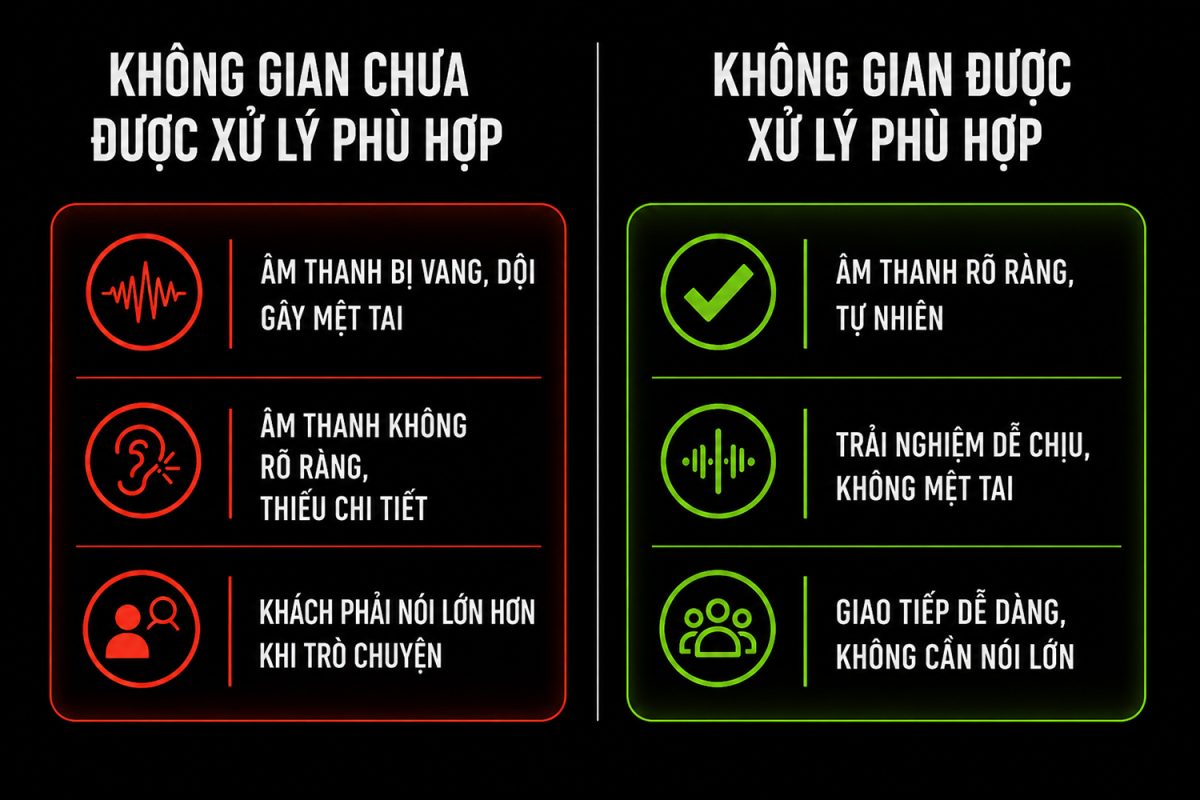
This is why a high-quality sound system still needs a suitably prepared room and appropriate nightclub soundproofing.
Expensive equipment can reproduce sound very well. It cannot, by itself, control the room’s reverberation, seal gaps around doors, or prevent sound from passing through walls, ceilings, floors, and air-conditioning ducts.
When Noise Generates More Noise
One notable point in Noxon’s paper is the way noise can generate further noise.
As background noise rises, people tend to speak louder to hear one another. When more people raise their voices, the overall level rises again. The space becomes increasingly noisy and conversation becomes harder.
In a hospitality venue, the cycle can develop as follows:

The issue may be less obvious when the venue is quiet. At peak times, many sound sources operate together: music, orders being called, traffic, conversations, adjacent areas, and building services.
Guests may not know the technical name for the problem. They can still feel that spending a long time in the space is uncomfortable.

Soundproofing, Room Acoustics, and System Design
Three closely related tasks need to be distinguished:
Soundproofing limits sound transmission to surrounding areas and reduces outside noise entering the venue.
Room acoustic treatment controls reverberation, echoes, and unwanted reflections.
Sound system design determines the loudspeaker distribution, coverage directions, and appropriate operating levels for the room.

These tasks are closely connected, but one cannot replace the others.
For example, reducing the volume may lower the sound leaving a venue. Problems can persist if doors have large gaps, shared walls have not been assessed, or air-conditioning ducts provide sound paths between areas.
Noxon describes outside noise entering through windows, doors, walls, corridors, gaps beneath doors, and ventilation ducts. Air-conditioning equipment can also transmit vibration into the building structure.
Why Plan Nightclub Soundproofing from the Start?
For nightclubs and hospitality venues inside buildings, close to homes, or sharing structures with other premises, soundproofing should be considered during planning.
Early consideration allows it to be coordinated with the architecture, interior design, air conditioning, and loudspeaker layout.
Remedial work after opening is often more complicated. The team must identify the paths carrying sound out, locate sources of vibration or noise, and consider the impact on the interior and daily operation.

Noise also affects the venue’s operation. Breaching applicable technical noise limits can lead to penalties and requirements for mitigation. Serious cases may result in temporary suspension of operations.
Where Should an Operating Venue Start?
When complaints come from the building or surrounding areas, identify the cause before spending more money.
Useful initial questions include:
- At what times do complaints tend to occur?
- Where outside the venue is the sound most noticeable?
- Do entrance doors have large gaps, or are they frequently left open?
- Are walls, ceilings, or floors shared with other premises?
- Do air-conditioning ducts or corridors connect different areas?
- Is the complaint mainly about audible music, bass vibration, or both?
- Are the loudspeaker positions and aiming appropriate?
- Are there many glass, concrete, or other hard surfaces causing reflections inside?
Some temporary measures may reduce the impact while a survey is arranged:
- Lower operating levels during sensitive hours.
- Inspect and seal gaps around entrance doors.
- Reduce repeated door opening while the system is operating.
- Check loudspeaker positions and aiming.
- Record the time, location, and nature of each complaint.
Thick curtains, soft furnishings, and carpets may reduce some reflections inside the room. They should not be treated as a complete soundproofing solution.
Requirements differ between venue types. To avoid spending time and money on ineffective measures, nightclub soundproofing should be handled by experienced specialists.
Final Thoughts
Equipping a venue involves more than selecting good loudspeakers.
It also means understanding how sound interacts with the room, how to make the experience comfortable inside, and how to limit its effect on surrounding areas.
A well-designed sound system can transform the experience. Expensive equipment alone cannot compensate for problems in the room or building.
The aim is to account for these factors early. Once a venue is operating, every problem cannot be solved with the volume control.
B-STAR TRADING – SERVICE – DEVELOPMENT COMPANY LIMITED
Unit B-3, Quang Thai Building, 111B Ly Thanh Tong Street, Phu Thanh Ward, Ho Chi Minh City
Hotline: (+84) 911 171 969
Email: info@b-star.vn