
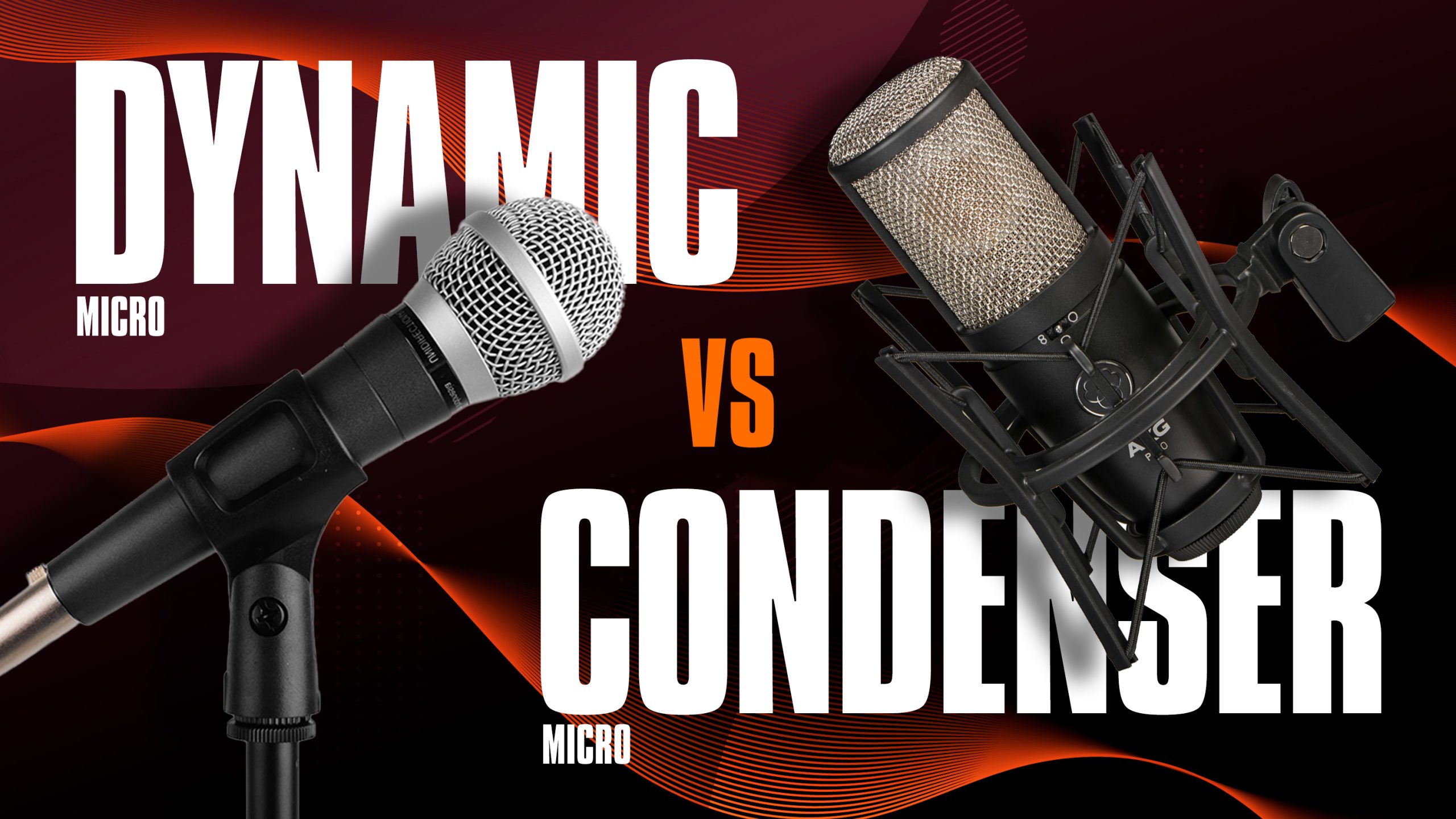
Chọn Dynamic hay Condenser micro

Dynamic vs Condenser Microphones: How to Choose

Blog
Chọn Dynamic hay Condenser micro

Dynamic vs condenser microphones is a common choice in live sound. Both types are widely used, but their operating principles and practical strengths differ.

Dynamic microphones are especially common on stage. They are generally rugged and reliable, with prices ranging from inexpensive models to professional designs costing several hundred dollars. Their individual frequency responses can suit particular voices, instruments, and performance environments.

Condenser microphones often offer detailed high-frequency reproduction and a fast response to transients. They are widely used for drum overheads, hi-hats, and studio recording, as well as many live applications.

Here is how the two types work and what to consider when choosing between them.

Dynamic vs Condenser Microphones: The Main Differences

Dynamic Microphones

Cross-section showing a dynamic microphone’s diaphragm, coil, and magnet

Cross-section of a dynamic microphone

A moving-coil dynamic microphone works on a principle similar to a loudspeaker in reverse. Sound moves a diaphragm connected to a small coil suspended in a magnetic field. The coil’s movement generates an electrical signal, which is sent to the mixing console.

The relatively simple construction makes this type practical for demanding use. Many models handle high sound pressure levels well, although performance always depends on the particular design.

Condenser Microphones

Cross-section showing a condenser microphone’s diaphragm and backplate

Cross-section of a condenser microphone

A condenser microphone uses a thin conductive diaphragm and a nearby backplate to form a capacitor. Sound moves the diaphragm, changing the capacitance. The microphone’s electronics convert this variation into a usable audio signal.

Condenser microphones require power for their electronics, commonly from phantom power or, in some designs, a battery. They are often selected for detailed vocal and instrument recording.

Ambient pickup and feedback depend on the microphone’s polar pattern, placement, and the sound system. Being a condenser does not, by itself, make a microphone unsuitable for a live stage.

Some microphone and voice combinations emphasize an already bright upper-midrange. Choosing a suitable vocal microphone means considering the singer’s voice as well as the microphone’s overall quality.

48 V Phantom Power

48 V phantom power for a condenser microphone

Phantom power for a condenser microphone

Condenser microphones need a suitable power source. Some use batteries or a dedicated external supply, while many receive power through the microphone cable.

With a 48 V phantom supply, the same DC voltage is applied to XLR pins 2 and 3 relative to pin 1, the shield reference. In a correctly wired balanced connection, this arrangement allows power and audio to share the cable.

Many mixers and audio interfaces provide phantom power. Check the microphone’s required voltage and current, and the capabilities of the connected input.

Different microphones draw different amounts of current. An inadequate supply may reduce available output or increase distortion, even if the microphone still passes a signal.

The Engineer’s Role in Vocal Microphone Setup

A performance can use microphones for vocals, cymbals, guitar, piano, and many other sources. Here, the focus is on vocal microphones and the engineer’s work with the singer.

The engineer listens for changes caused by distance, angle, and vocal level. Singing very close to a directional microphone may increase bass through proximity effect; excessive level can also overload some parts of the signal chain.

Before making extensive processing changes, the engineer helps the singer use the microphone consistently. Comparing the sound close to the microphone with the sound farther away makes those differences easier to hear.

Dynamic microphones are a common, practical choice for live vocals. The best choice still depends on the model, singer, stage layout, monitoring, and operating level.

A Real Example: Matching a Microphone to a Voice

During electronic pop duo La Roux’s Gold Tour, sound engineer Dave Swallow had worked with the act for more than a year and brought extensive experience with Sennheiser products.

Discussing the SKM 500-945 chosen to replace the Neumann KMS 104 previously used by singer Elly Jackson, he explained:

“The SKM 500-945 has some low frequencies that can add warmth to the voice. Elly Jackson liked its tone too. She previously had a Neumann KMS 104, which is a very good microphone, but it did not suit her voice. She sings in the upper-midrange, which can be bright, and that microphone brought those frequencies forward, so the vocal could sound a little harsh.”

“When I changed to the 945, there was suddenly some low end in her voice, and it sounded fuller and more balanced. I found it a really good match between the voice and the microphone.”

La Roux singer Elly Jackson with a Sennheiser vocal microphone

La Roux singer Elly Jackson with a Sennheiser 500-945 microphone

Choosing the Right Microphone

The choice between dynamic vs condenser microphones depends on the application and the performer’s technique, as well as the microphone itself.

Dynamics are often a strong practical option for demanding stage use. Condensers are frequently selected for detailed studio recording and sources such as overheads, hi-hats, cymbals, and percussion. Both types can perform well in live sound when selected and positioned appropriately.

For the next step, read about how microphone handling affects the sound (Vietnamese).

Xem chi tiết

Leave a Reply

Your email address will not be published. Required fields are marked *