Loudspeaker Selection: Does Your System Suit the Space?

Blog

Loudspeaker Selection for Domes, High Ceilings, and Glass Walls

Common Sound Problems in Reflective Spaces

Have you heard a room with good loudspeakers that still sounds boomy or uneven, with some seats much louder than others? The result can fall short of what you expected from the investment.

These three loudspeaker selection considerations can help you assess a proposal before committing your budget.

What Happens When the Audio Solution Does Not Suit the Room?

Rooms with glass walls, columns, high ceilings, and hard stone or tile surfaces are often prone to reflections. An unsuitable system can create several problems:

  • Sound reaching the ceiling and walls can produce reflections and reverberation that reduce speech clarity.Reflections in a room with hard surfaces
  • Seats close to the loudspeakers may be uncomfortably loud, while distant seats or obstructed areas receive insufficient sound.Uneven sound levels near and far from loudspeakers
  • Turning the system up to reach the back of a large room may send more energy onto reflective surfaces without adequately serving the audience.

Three Technical Criteria for Clear, Consistent Coverage

1. Control Vertical Coverage

Choose loudspeakers with vertical coverage suited to the room. Appropriate directivity helps keep energy on the audience and reduces unnecessary sound reaching the ceiling and floor.
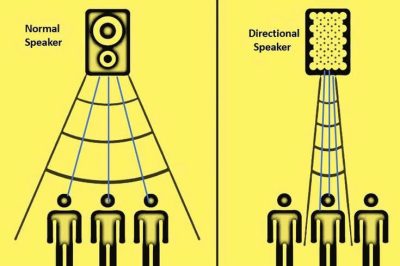
Loudspeaker selection and controlled vertical coverage

The benefit: fewer unwanted reflections can support clearer speech in reverberant spaces. Horizontal aiming must also be considered to control sound reaching side walls.

2. Use Acoustic Prediction Software

Professional system designers use prediction software before installation to assess coverage across large spaces.
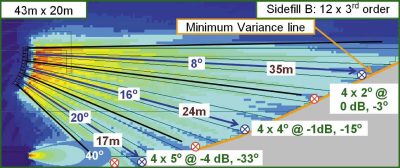
Predicted loudspeaker coverage in a room model

A model can incorporate the room’s dimensions, heights, loudspeaker data, and proposed positions to predict the sound distribution. The results depend on the accuracy of the model and should be checked during commissioning.

The benefit: a better basis for selecting loudspeaker quantities, mounting positions, and aiming, reducing over-covered and under-covered areas.


3. Match Throw and System Type to the Architecture

The appropriate combination of point-source loudspeakers, line arrays, and supplementary loudspeakers depends on the project’s size and purpose. The goal is consistent coverage across the audience while respecting the architecture.

Final Thoughts on Loudspeaker Selection

In architecturally sensitive or sacred spaces, extensive physical acoustic treatment may be restricted. Loudspeaker choice, positions, aiming, and engineering experience then become particularly important.

Before selecting a system, ask the specialist:

  • What type of room is this loudspeaker designed to serve?
  • Can the proposed coverage be modeled for this space?
  • Will the array cover the complete audience area, or are supplementary loudspeakers needed?

An experienced installation partner can explain these decisions, protect the budget, and contribute lasting value to the venue.

For project examples, explore B-Star’s completed installations.

Xem chi tiết

Leave a Reply

Your email address will not be published. Required fields are marked *